 Add to Chrome
 Add to Firefox
 Add to Edge
DriveWAM: Video Generative Priors Enable Scalable World-Action Modeling for Autonomous Driving
May 27, 2026
Pretrained foundation models have become an important basis for end-to-end autonomous driving. In contrast to vision-language models pretrained primarily on static image-text pairs, video generative models capture temporal dynamics and motion priors that are naturally suited for driving. We present DriveWAM, a driving world-action model that adapts a pretrained video diffusion transformer into an autoregressive video-action policy. DriveWAM organizes video and action streams into a unified temporal token sequence and trains them under a joint flow-matching objective, preserving the pretrained video-generation architecture while adapting its large-scale video priors to action generation. To incorporate high-level scene understanding, we introduce scene-evolving driving guidance, where a frozen VLM produces chunk-specific semantic intent to guide video-action generation. To keep long-horizon rollout bounded, we further introduce selective KV memory, which maintains bounded modality-aware video and action memory pools through relevance-redundancy cache selection at inference time. Experiments on NAVSIM and the PhysicalAI-Autonomous-Vehicles benchmark show that DriveWAM achieves strong planning performance, and a data-scaling study from 4k to 100k driving clips further confirms the scaling potential of world-action modeling for end-to-end autonomous driving.

Stabilizing Streaming Video Geometry via Dynamic Feature Normalization
May 25, 2026Consistent 3D geometry estimation from streaming RGB input is crucial for real-world applications such as autonomous driving, embodied AI, and large-scale reconstruction. While modern monocular geometry foundation models achieve strong single-image accuracy, they exhibit severe temporal inconsistency on continuous input, notably dominated by scale--shift drifting. Through targeted empirical analysis, we trace this instability to its root cause: fluctuations in latent feature statistics, whose mean and variance directly determine the predicted depth's scale and shift. Building on this insight, we introduce Dynamic Feature Normalization (DyFN), a lightweight, causal recurrent module that dynamically and robustly modulates feature statistics to maintain stable geometry over time. We adapt powerful pretrained monocular geometry models for streaming by finetuning only DyFN, a mere 2\% additional parameters, while keeping the backbone frozen, thereby achieving temporal consistency without compromising single-image accuracy. Extensive experiments across four benchmarks show that DyFN effectively eliminates temporal artifacts such as disjointed layering and positional jitter, and achieves state-of-the-art temporal stability, improving over prior streaming methods by up to 14\% and even outperforming heavier non-causal video baselines. Project Page: https://shawlyu.github.io/DyFN
OneDrive: Unified Multi-Paradigm Driving with Vision-Language-Action Models
Apr 20, 2026Vision-Language Models(VLMs) excel at autoregressive text generation, yet end-to-end autonomous driving requires multi-task learning with structured outputs and heterogeneous decoding behaviors, such as autoregressive language generation, parallel object detection and trajectory regression. To accommodate these differences, existing systems typically introduce separate or cascaded decoders, resulting in architectural fragmentation and limited backbone reuse. In this work, we present a unified autonomous driving framework built upon a pretrained VLM, where heterogeneous decoding behaviors are reconciled within a single transformer decoder. We demonstrate that pretrained VLM attention exhibits strong transferability beyond pure language modeling. By organizing visual and structured query tokens within a single causal decoder, structured queries can naturally condition on visual context through the original attention mechanism. Textual and structured outputs share a common attention backbone, enabling stable joint optimization across heterogeneous tasks. Trajectory planning is realized within the same causal LLM decoder by introducing structured trajectory queries. This unified formulation enables planning to share the pretrained attention backbone with images and perception tokens. Extensive experiments on end-to-end autonomous driving benchmarks demonstrate state-of-the-art performance, including 0.28 L2 and 0.18 collision rate on nuScenes open-loop evaluation and competitive results (86.8 PDMS) on NAVSIM closed-loop evaluation. The full model preserves multi-modal generation capability, while an efficient inference mode achieves approximately 40% lower latency. Code and models are available at https://github.com/Z1zyw/OneDrive
LIVE: Long-horizon Interactive Video World Modeling
Feb 03, 2026Autoregressive video world models predict future visual observations conditioned on actions. While effective over short horizons, these models often struggle with long-horizon generation, as small prediction errors accumulate over time. Prior methods alleviate this by introducing pre-trained teacher models and sequence-level distribution matching, which incur additional computational cost and fail to prevent error propagation beyond the training horizon. In this work, we propose LIVE, a Long-horizon Interactive Video world modEl that enforces bounded error accumulation via a novel cycle-consistency objective, thereby eliminating the need for teacher-based distillation. Specifically, LIVE first performs a forward rollout from ground-truth frames and then applies a reverse generation process to reconstruct the initial state. The diffusion loss is subsequently computed on the reconstructed terminal state, providing an explicit constraint on long-horizon error propagation. Moreover, we provide an unified view that encompasses different approaches and introduce progressive training curriculum to stabilize training. Experiments demonstrate that LIVE achieves state-of-the-art performance on long-horizon benchmarks, generating stable, high-quality videos far beyond training rollout lengths.
ColaVLA: Leveraging Cognitive Latent Reasoning for Hierarchical Parallel Trajectory Planning in Autonomous Driving
Dec 31, 2025Autonomous driving requires generating safe and reliable trajectories from complex multimodal inputs. Traditional modular pipelines separate perception, prediction, and planning, while recent end-to-end (E2E) systems learn them jointly. Vision-language models (VLMs) further enrich this paradigm by introducing cross-modal priors and commonsense reasoning, yet current VLM-based planners face three key challenges: (i) a mismatch between discrete text reasoning and continuous control, (ii) high latency from autoregressive chain-of-thought decoding, and (iii) inefficient or non-causal planners that limit real-time deployment. We propose ColaVLA, a unified vision-language-action framework that transfers reasoning from text to a unified latent space and couples it with a hierarchical, parallel trajectory decoder. The Cognitive Latent Reasoner compresses scene understanding into compact, decision-oriented meta-action embeddings through ego-adaptive selection and only two VLM forward passes. The Hierarchical Parallel Planner then generates multi-scale, causality-consistent trajectories in a single forward pass. Together, these components preserve the generalization and interpretability of VLMs while enabling efficient, accurate and safe trajectory generation. Experiments on the nuScenes benchmark show that ColaVLA achieves state-of-the-art performance in both open-loop and closed-loop settings with favorable efficiency and robustness.
GeoPredict: Leveraging Predictive Kinematics and 3D Gaussian Geometry for Precise VLA Manipulation
Dec 18, 2025Vision-Language-Action (VLA) models achieve strong generalization in robotic manipulation but remain largely reactive and 2D-centric, making them unreliable in tasks that require precise 3D reasoning. We propose GeoPredict, a geometry-aware VLA framework that augments a continuous-action policy with predictive kinematic and geometric priors. GeoPredict introduces a trajectory-level module that encodes motion history and predicts multi-step 3D keypoint trajectories of robot arms, and a predictive 3D Gaussian geometry module that forecasts workspace geometry with track-guided refinement along future keypoint trajectories. These predictive modules serve exclusively as training-time supervision through depth-based rendering, while inference requires only lightweight additional query tokens without invoking any 3D decoding. Experiments on RoboCasa Human-50, LIBERO, and real-world manipulation tasks show that GeoPredict consistently outperforms strong VLA baselines, especially in geometry-intensive and spatially demanding scenarios.
UniSplat: Unified Spatio-Temporal Fusion via 3D Latent Scaffolds for Dynamic Driving Scene Reconstruction
Nov 06, 2025Feed-forward 3D reconstruction for autonomous driving has advanced rapidly, yet existing methods struggle with the joint challenges of sparse, non-overlapping camera views and complex scene dynamics. We present UniSplat, a general feed-forward framework that learns robust dynamic scene reconstruction through unified latent spatio-temporal fusion. UniSplat constructs a 3D latent scaffold, a structured representation that captures geometric and semantic scene context by leveraging pretrained foundation models. To effectively integrate information across spatial views and temporal frames, we introduce an efficient fusion mechanism that operates directly within the 3D scaffold, enabling consistent spatio-temporal alignment. To ensure complete and detailed reconstructions, we design a dual-branch decoder that generates dynamic-aware Gaussians from the fused scaffold by combining point-anchored refinement with voxel-based generation, and maintain a persistent memory of static Gaussians to enable streaming scene completion beyond current camera coverage. Extensive experiments on real-world datasets demonstrate that UniSplat achieves state-of-the-art performance in novel view synthesis, while providing robust and high-quality renderings even for viewpoints outside the original camera coverage.
Foresight in Motion: Reinforcing Trajectory Prediction with Reward Heuristics
Jul 16, 2025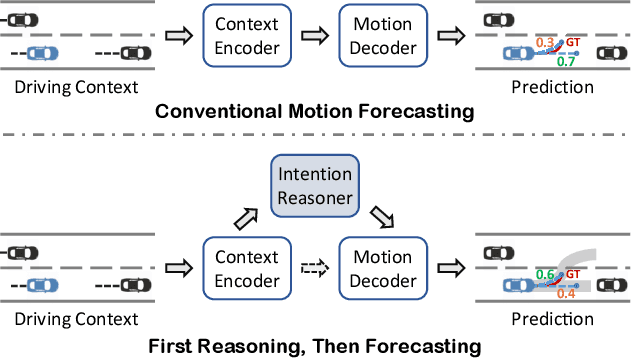
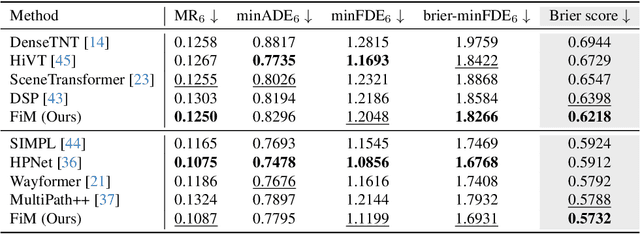
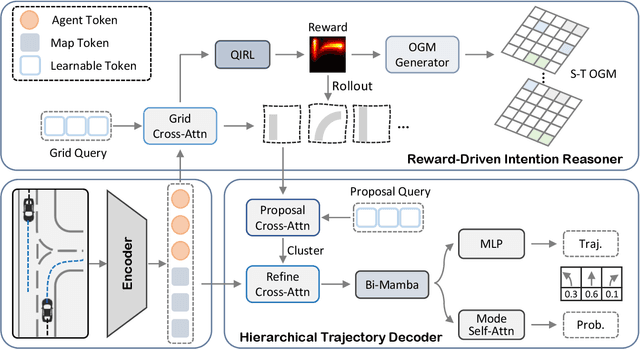

Motion forecasting for on-road traffic agents presents both a significant challenge and a critical necessity for ensuring safety in autonomous driving systems. In contrast to most existing data-driven approaches that directly predict future trajectories, we rethink this task from a planning perspective, advocating a "First Reasoning, Then Forecasting" strategy that explicitly incorporates behavior intentions as spatial guidance for trajectory prediction. To achieve this, we introduce an interpretable, reward-driven intention reasoner grounded in a novel query-centric Inverse Reinforcement Learning (IRL) scheme. Our method first encodes traffic agents and scene elements into a unified vectorized representation, then aggregates contextual features through a query-centric paradigm. This enables the derivation of a reward distribution, a compact yet informative representation of the target agent's behavior within the given scene context via IRL. Guided by this reward heuristic, we perform policy rollouts to reason about multiple plausible intentions, providing valuable priors for subsequent trajectory generation. Finally, we develop a hierarchical DETR-like decoder integrated with bidirectional selective state space models to produce accurate future trajectories along with their associated probabilities. Extensive experiments on the large-scale Argoverse and nuScenes motion forecasting datasets demonstrate that our approach significantly enhances trajectory prediction confidence, achieving highly competitive performance relative to state-of-the-art methods.
Edit360: 2D Image Edits to 3D Assets from Any Angle
Jun 12, 2025Recent advances in diffusion models have significantly improved image generation and editing, but extending these capabilities to 3D assets remains challenging, especially for fine-grained edits that require multi-view consistency. Existing methods typically restrict editing to predetermined viewing angles, severely limiting their flexibility and practical applications. We introduce Edit360, a tuning-free framework that extends 2D modifications to multi-view consistent 3D editing. Built upon video diffusion models, Edit360 enables user-specific editing from arbitrary viewpoints while ensuring structural coherence across all views. The framework selects anchor views for 2D modifications and propagates edits across the entire 360-degree range. To achieve this, Edit360 introduces a novel Anchor-View Editing Propagation mechanism, which effectively aligns and merges multi-view information within the latent and attention spaces of diffusion models. The resulting edited multi-view sequences facilitate the reconstruction of high-quality 3D assets, enabling customizable 3D content creation.
TrajFlow: Multi-modal Motion Prediction via Flow Matching
Jun 10, 2025Efficient and accurate motion prediction is crucial for ensuring safety and informed decision-making in autonomous driving, particularly under dynamic real-world conditions that necessitate multi-modal forecasts. We introduce TrajFlow, a novel flow matching-based motion prediction framework that addresses the scalability and efficiency challenges of existing generative trajectory prediction methods. Unlike conventional generative approaches that employ i.i.d. sampling and require multiple inference passes to capture diverse outcomes, TrajFlow predicts multiple plausible future trajectories in a single pass, significantly reducing computational overhead while maintaining coherence across predictions. Moreover, we propose a ranking loss based on the Plackett-Luce distribution to improve uncertainty estimation of predicted trajectories. Additionally, we design a self-conditioning training technique that reuses the model's own predictions to construct noisy inputs during a second forward pass, thereby improving generalization and accelerating inference. Extensive experiments on the large-scale Waymo Open Motion Dataset (WOMD) demonstrate that TrajFlow achieves state-of-the-art performance across various key metrics, underscoring its effectiveness for safety-critical autonomous driving applications. The code and other details are available on the project website https://traj-flow.github.io/.